Rare Books
Let's eat : "indestructible" panoramas
Image not available
You might also be interested in
Image not available
Let's play : "indestructible" panoramas
Rare Books
A picture book without words showing common household pets and children's toys.
654824
Image not available
Merry-go-round : "indestructible" merry-go-round pictures
Rare Books
A picture book without words showing children in merry-go-round scenes.
654825
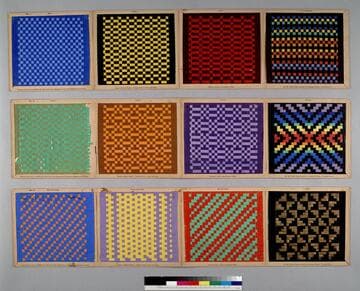
Books without Words. (Volume First)--Color and Form
Visual Materials
One set of paper weavings created by Emily M. Coe, ca. 1880. The set is comprised of five "books," plus three loose "pages" of paper weavings "manufactured only by Emily M. Coe, New York, originator of American Kindergarten System." They are marked "No. 1"-"No. 4"; only the 5th book is unnumbered. There are a total of 23 paper weavings, four per book plus the three loose pages. Each "book" has its title on the bottom of the third page, such as "Primary Colors--Curvilinear Solids," the first part of the title refers to the four paper weavings, the latter, the printed objects on the reverse of each page. For example, Book "No. 1,", "Primary Colors--Curvilinear Solids" has one page labeled "Blue" showing two tones of blue woven together, and on the reverse a shaded ball; the next is "Yellow" showing yellow and black interwoven, on the reverse a shaded oval; the third is "Red" showing red and a russet color mixed, with a shaded cylinder; and the last page is "Mixed Primaries" showing color changes as primaries mix, and on the reverse a shaded cone. The other "books" are labeled: No. 2, "Secondary Colors--Rectilinear Solids"; No. 3, "Complimentary Colors and Quadrangles"; No. 4, "Tertiary Colors--Polygons"; and the fifth, "Mixed Tertiaries--Triangles". The fourth paper weaving in each of the books is somewhat different than the others. In Books 3-5 there are black and gold weavings entitled "Fancy", with the weavings from 4 and 5 spelling out the words "FOR MA" and "FOR PAPA" respectively. Also of note: in the corners of the first drawing image are trademarks in the upper right and left corners, on the bottom corners are reproductions of a medal, one side of which reads "International Exhibition, Philadelphia MDCCCLXXVI". "Miss Ida Young[?]" is written, in ms., on top of the unnumbered fifth book.
ephKAEE
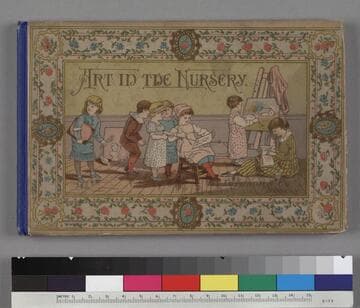
Art in the Nursery
Visual Materials
One drawing book entitled Art in the Nursery, published for D. Lothrop & Company, Boston, by John Wilson & Son/University Press, 1879. The front cover shows seven children in a room, three of whom are painting. The image is bordered by flowers. The back cover is an advertisement for The Children's Almanac, by Ella Farman. The title page is subtitled Pictures for Baby to draw and Pictures for Baby to laugh at. Opposite the title page is an image of a laughing Santa Claus. The book appears to be a slightly different, smaller, edition of the same book in box 30, Env. 15. There are 29 images, as opposed to 61; sheets of tissue paper have been inserted between the images; and some of the images, both slate and comical, differ from those in Env. 15. Twelve of the images are done in white on black with a wood border--mimicking images drawn on slates with chalk. These images were intended for the children to copy onto their own slates. The other 17 images are children at play, or anthropomorphised animals at play, with amusing captions. Many of the images are signed by the artists, including J G Francis, Palmer Cox, and "Koz". The first comical image has been traced onto the tissue paper insert with pencil. On the inside cover, written in ms., in pencil, is an inscription "Franklin, from Aunt Eunice" and above it, also in pencil, "1879."
ephKAEE
Image not available
The Jewish bride : a photo play
Rare Books
"The Jewish Bride is a photo-novella, or, as its author Jeremy Stigter likes to call it, a photo-play. The Jewish Bride is a singular work of art. It is, in a way, a story book for grown-ups. A story that is both intimate and chilling. There are no words, just 58 pictures, one after the other, like a silent movie without the piano. And, as in a silent movie, it is all played out in black and white. Bit by bit, as one image follows the other, a narrative unfolds. The story told is basically simple, banal even as it concerns a romantic encounter between a man and a woman. It happens to go wrong. Or seems to, in any case. Another dimension, unexpected, dream-like, imposes itself. It is this very particular surreal feeling, mixed with a fair dose of black humor, which gives The Jewish Bride its distinct character. Having finished the story, the reader/spectator will inevitably turn back the pages, to the beginning, the middle, the end"--Publisher's description.
653165
Image not available
Dreamers of decadence : symbolist painters of the 1890s
Rare Books
"There have been few movements in the history of Western art as strange as that of the Decadents of the last quarter of the nineteenth century. While public attention (like that of most later critics) was preoccupied with the Impressionists, many painters were reacting in a totally different -- and more imaginative way -- to the grim horrors of the new industrial society around them. The roots of the Decadents, as these artists came to call themselves, were to be found in the poetic visions of the English Pre-Raphaelites of the 1850's. Their first great Continental exponent was a brilliant and neglected painter of the fantastic, Gustave Moreau; their most obvious expression was Art Nouveau, a style closely interwoven with sinuous and half-unconscious eroticism. Philippe Jullian takes the reader on a conducted tour through the bizarre symbolism of this half-forgotten world, introducing him to a large number of writers and artists. Many of these artists -- Moreau; Toorop, the brilliant half-Balinese, half-Dutch painter and draftsman; the French Odilon Redon, the great master of Symbolist art; the Viennese Klimt; and the Belgian Khnopff -- have been known for some time to a few enthusiasts: In this lively study their inventiveness and skill are explored afresh, and their fantastic imaginings and weird symbolism exposed to a sometimes ironic light. Proud of their romantic appearance, extravagant habits, and outragous conduct, the artists of the "mauve nineties" drew on a wide range of writers for their ideas, including not only Edgar Allan Poe, Baudelaire, Swinburne, and Wilde, but also a number of less well-known and stranger poets. The book ends with a short anthology of Symbolist themes taken from these writers, which form a counterpart to the 149 extraordinary pictures drawn from the neglected reserves of museums and collections all over Europe and America. Dreamers of Decadence brings to life a fascinating episode in the history of ideas, which foreshadows today's interest in fantasy and preoccupation with the symbols of love and apprehension"--Back cover.
608272