Rare Books
Never forget
Image not available
You might also be interested in
Image not available
Impossible to forget : the Nazi camps fifty years after
Rare Books
"Michael Kenna photographed Nazi concentration and extermination camps from 1988 to 2000, subsequently donating all negatives, prints and their respective rights to the French Government and the Caen Memorial. Kenna first visited the Natzweiler-Struthof concentration camp in France in 1986. Two years later he returned, still marked by the initial emotional impact, no doubt the key to his decision to develop a project about the Holocaust. Since then, he has repeatedly returned to Auschwitz, Sachsenhausen, Lublin-Majdanek, Ravensbruck, Buchenwald and many other camps to photograph their restless emptiness. Overwhelmed by the abomination of the gas chambers and by the inexpressible suffering of the victims, Kenna wanted to share a memory that he found impossible to forget. Knowing that a work of art can be an invitation to meditation, he went to the concentration camps to photograph what they had become: sites of contemplation. The photographs in 'Impossible to Forget' are directly opposed to the evil that continues to live in the camps, to nihilism and to revisionism; they are bearers of peace and compassion"--Publisher's description.
653188
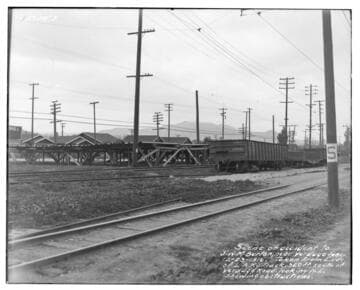
Scene of accident with JWM Burton
Visual Materials
Scene of accident with JWM Burton - near Verdugo Junction. Accident occurred - PL&P Corp. machine #78 hit by L. A. Ry. trolley car at 11pm. Shot taken on East side of L.A. Railway Track about 360 feet South of Verdugo Road looking Northwest and showing obstructions to view. Taken at about elevation of motorman's head while in street car. Shot taken at 1:30 P.M.
photCL SCE 03 - 00839
Image not available
Ōmizuao
Rare Books
"Omizuao is an accordion-bound 'pillow book'--A collection of landscapes, flowers and female nudes. The artist has used the accordion-bound format to create an installation which measures some 14 feet when fully opened, but which can also be viewed as 45 individual spreads ... hand bound in two clear-lacquered hardwood covers, and presented in a matching wooden box."--Publisher's description.
653306
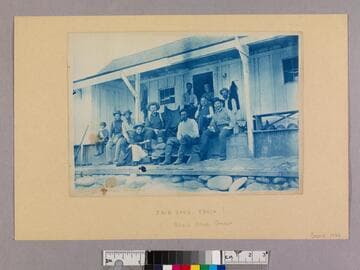
Ranch house group
Visual Materials
A group of men, women, and children sit or stand on the porch of a plain wood house. Rocks reinforce the foundation under the porch. Most wear hats, some of them men smoke pipes or cigarettes.
photCL 6
Image not available
Motion Picture: Forget Paris, 1995 (2)
Visual Materials
This collection consists of photographs of billboards located in situ primarily in and around Los Angeles and, to a lesser extent, San Diego, from approximately 1930-1996 (bulk 1950-1989). The photographs, which are principally color slides (35mm) and film negatives (both black-and-white and color), were created by Pacific Outdoor Advertising Company (POA) and Gannett Outdoor Company for internal purposes and represent advertising for a wide variety of businesses, consumer products, and services, including beverages (many for beer and liquor); food; cigarettes and tobacco; transportation (especially automobiles, airlines and bus lines); hotels; restaurants; motion pictures; charitable and non-profit organizations, including regional cities and civic campaigns; political candidates for local and state elections; public service announcements (such as air raid and Cold War-related ads); radio and television stations; oil and gasoline companies; cemeteries; clothing companies; department stores; recreational facilities; and other commercial, political, civic, and institutional clients. In addition, there are images related primarily to Pacific Outdoor Advertising (POA) Company operations such as client presentations, billboard production and installation, corporate facilities and the POA helicopter. Aerial views taken throughout Southern California document the various markets in which the company placed signage.
Group 1316
Image not available
Forget-Me-Not Brand
Visual Materials
The Citrus label collection contains more than 1,500 lithographed labels related to the California citrus industry in the United States from 1880 to 1960, with the bulk of the collection dating from 1890 to 1940. The vast majority of the collection consists of lithographed labels produced for Californian growers, packers, and distributors to identify brand names and packing locations on wooden shipping crates of oranges, lemons and grapefruits. Many of the labels were printed by Los Angeles and San Francisco lithographers. The collection includes a range of lithography techniques from crayon drawing and hand stippling to the use of Ben Day screen patterns and half-tone lithography. The collection also includes more than 100 examples with "bronzing," a printing technique where varnish is printed on the label, followed by a dusting of fine bronze powder. A significant number of labels are stamped on verso with a received date by the Fruit Growers Supply Company, and some include signatures of approval or notations about printing corrections. The collection provides a broad view of the development of citrus fruit advertising over time, and also touches upon topics of commerce, manufacturing, travel and tourism, and promotion of the western United States. In the earliest examples, themes include naturalistic designs of flowers, animals, women, historical subjects, and scenic landscapes. Brand names, simple designs, block letters, and geometric patterns dominate in later examples. Many of the labels depict orange groves, scenic views, or flowers, though the collection also includes a wide variety of imagery beyond these themes including Native Americans, transportation, children, and portraits of famous or fictional people.
ephCL F_46