Visual Materials
Take the Chicago Rock Island and Pacific R.R for Peoria, Des Moines, Council Bluffs
You might also be interested in
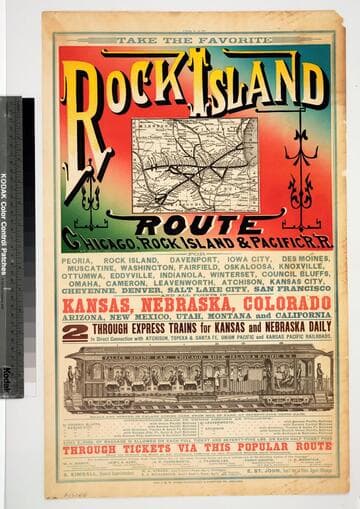
Take the favorite Rock Island route Chicago, Rock Island & Pacific R.R. : For Peoria, Rock Island, Davenport, Iowa City, Des Moines
Visual Materials
Image of a poster with promotional text and timetable for the Rock Island railroad route of the Chicago, Rock Island and Pacific Railroad with a center wood-engraved image of a map of a portion of the Midwestern United States showing railroad lines and a wood-engraved vignette in the lower part of the poster of a cross section of the "Palace Dining Car" showing the interior of the car with passengers eating and being served by African-American waiters.
priJLC_TRAN_001161
Image not available
Map of the Chicago & North-Western Railway and part of its connections
Visual Materials
This collection contains more than 730 printed items that relate to land-based modes of transportation primarily in the United States from the 1820s to the early 1900s. The bulk of the collection dates from 1840 to 1905 and consists largely of advertising and promotional materials, business records, and illustrations produced for or pertaining to the bicycle, carriage and wagon, railroad, and freight and passenger transport industries. The collection has 167 large-size items consisting of advertising cards, posters, broadsides, system maps, timetables, views, and other visual materials primarily produced for railroad companies, with additional items concerning vehicle and part manufacturers such as wheel works, carriage builders, bicycle manufacturers, and locomotive machine shops. Small-size items in the collection number more than 570 and are comprised mainly of advertising and promotional ephemera and business documents such as printed booklets, business cards, calendars, catalogs, envelopes, handbills, labels, leaflets, postcards, trade cards, and separated book and periodical illustrations, as well as stationery with printed billheads and letterheads filled out with manuscript or typewritten correspondence. The collection touches on topics of transportation, commerce and manufacturing, technology and engineering, travel and tourism, and geography. The images are primarily promotional in nature and provide information about the history of the American railroad, bicycle, and horse-drawn vehicle industries and the evolution of their advertising strategies in the 19th and early 20th centuries. As graphic materials, the prints offer evidence of the development of printmaking techniques and trends, and of the artists, engravers, lithographers, printers, and publishers involved in the creation of these prints.
priJLC_TRAN_001178
Image not available
Railroad (between 8 x 10 inches and 11 x 14 inches in size)
Visual Materials
This collection contains more than 730 printed items that relate to land-based modes of transportation primarily in the United States from the 1820s to the early 1900s. The bulk of the collection dates from 1840 to 1905 and consists largely of advertising and promotional materials, business records, and illustrations produced for or pertaining to the bicycle, carriage and wagon, railroad, and freight and passenger transport industries. The collection has 167 large-size items consisting of advertising cards, posters, broadsides, system maps, timetables, views, and other visual materials primarily produced for railroad companies, with additional items concerning vehicle and part manufacturers such as wheel works, carriage builders, bicycle manufacturers, and locomotive machine shops. Small-size items in the collection number more than 570 and are comprised mainly of advertising and promotional ephemera and business documents such as printed booklets, business cards, calendars, catalogs, envelopes, handbills, labels, leaflets, postcards, trade cards, and separated book and periodical illustrations, as well as stationery with printed billheads and letterheads filled out with manuscript or typewritten correspondence. The collection touches on topics of transportation, commerce and manufacturing, technology and engineering, travel and tourism, and geography. The images are primarily promotional in nature and provide information about the history of the American railroad, bicycle, and horse-drawn vehicle industries and the evolution of their advertising strategies in the 19th and early 20th centuries. As graphic materials, the prints offer evidence of the development of printmaking techniques and trends, and of the artists, engravers, lithographers, printers, and publishers involved in the creation of these prints.
priJLC_TRAN
Image not available
Subseries B. Carriage and Wagon (small size)
Visual Materials
This collection contains more than 730 printed items that relate to land-based modes of transportation primarily in the United States from the 1820s to the early 1900s. The bulk of the collection dates from 1840 to 1905 and consists largely of advertising and promotional materials, business records, and illustrations produced for or pertaining to the bicycle, carriage and wagon, railroad, and freight and passenger transport industries. The collection has 167 large-size items consisting of advertising cards, posters, broadsides, system maps, timetables, views, and other visual materials primarily produced for railroad companies, with additional items concerning vehicle and part manufacturers such as wheel works, carriage builders, bicycle manufacturers, and locomotive machine shops. Small-size items in the collection number more than 570 and are comprised mainly of advertising and promotional ephemera and business documents such as printed booklets, business cards, calendars, catalogs, envelopes, handbills, labels, leaflets, postcards, trade cards, and separated book and periodical illustrations, as well as stationery with printed billheads and letterheads filled out with manuscript or typewritten correspondence. The collection touches on topics of transportation, commerce and manufacturing, technology and engineering, travel and tourism, and geography. The images are primarily promotional in nature and provide information about the history of the American railroad, bicycle, and horse-drawn vehicle industries and the evolution of their advertising strategies in the 19th and early 20th centuries. As graphic materials, the prints offer evidence of the development of printmaking techniques and trends, and of the artists, engravers, lithographers, printers, and publishers involved in the creation of these prints.
priJLC_TRAN
Image not available
Carriage and Wagon, P-Z by company (8 x 10 inches or smaller in size)
Visual Materials
This collection contains more than 730 printed items that relate to land-based modes of transportation primarily in the United States from the 1820s to the early 1900s. The bulk of the collection dates from 1840 to 1905 and consists largely of advertising and promotional materials, business records, and illustrations produced for or pertaining to the bicycle, carriage and wagon, railroad, and freight and passenger transport industries. The collection has 167 large-size items consisting of advertising cards, posters, broadsides, system maps, timetables, views, and other visual materials primarily produced for railroad companies, with additional items concerning vehicle and part manufacturers such as wheel works, carriage builders, bicycle manufacturers, and locomotive machine shops. Small-size items in the collection number more than 570 and are comprised mainly of advertising and promotional ephemera and business documents such as printed booklets, business cards, calendars, catalogs, envelopes, handbills, labels, leaflets, postcards, trade cards, and separated book and periodical illustrations, as well as stationery with printed billheads and letterheads filled out with manuscript or typewritten correspondence. The collection touches on topics of transportation, commerce and manufacturing, technology and engineering, travel and tourism, and geography. The images are primarily promotional in nature and provide information about the history of the American railroad, bicycle, and horse-drawn vehicle industries and the evolution of their advertising strategies in the 19th and early 20th centuries. As graphic materials, the prints offer evidence of the development of printmaking techniques and trends, and of the artists, engravers, lithographers, printers, and publishers involved in the creation of these prints.
priJLC_TRAN
Image not available
Carriage and Wagon (between 8 x 10 inches and 11 x 14 inches in size)
Visual Materials
This collection contains more than 730 printed items that relate to land-based modes of transportation primarily in the United States from the 1820s to the early 1900s. The bulk of the collection dates from 1840 to 1905 and consists largely of advertising and promotional materials, business records, and illustrations produced for or pertaining to the bicycle, carriage and wagon, railroad, and freight and passenger transport industries. The collection has 167 large-size items consisting of advertising cards, posters, broadsides, system maps, timetables, views, and other visual materials primarily produced for railroad companies, with additional items concerning vehicle and part manufacturers such as wheel works, carriage builders, bicycle manufacturers, and locomotive machine shops. Small-size items in the collection number more than 570 and are comprised mainly of advertising and promotional ephemera and business documents such as printed booklets, business cards, calendars, catalogs, envelopes, handbills, labels, leaflets, postcards, trade cards, and separated book and periodical illustrations, as well as stationery with printed billheads and letterheads filled out with manuscript or typewritten correspondence. The collection touches on topics of transportation, commerce and manufacturing, technology and engineering, travel and tourism, and geography. The images are primarily promotional in nature and provide information about the history of the American railroad, bicycle, and horse-drawn vehicle industries and the evolution of their advertising strategies in the 19th and early 20th centuries. As graphic materials, the prints offer evidence of the development of printmaking techniques and trends, and of the artists, engravers, lithographers, printers, and publishers involved in the creation of these prints.
priJLC_TRAN